Why Does Honey Crystallize? (And Why It's a Good Sign)
You Opened Your Honey Jar and It's Solid. Don't Panic.
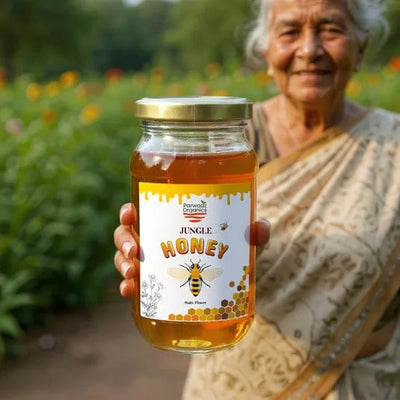
If you've ever reached for your honey jar after a few months and found it thick, cloudy, grainy, or completely set like butter — the honest, science-backed answer: your honey hasn't gone bad. What you're seeing is one of the strongest signs that you're holding a jar of real, pure raw honey.
This is called crystallisation, and it's the single best home-test for honey purity in India.
What Is Honey Crystallization?
Raw honey is what chemists call a supersaturated sugar solution. It contains roughly 70–80% natural sugars (mostly glucose and fructose) dissolved in just 17–20% water. That's far more sugar than the water can stably hold.
Over time, the glucose molecules begin to separate from the water and arrange themselves into tiny crystals. These crystals attract more glucose, growing larger and denser, until the entire jar takes on a thicker, grainy, or even solid texture. This isn't decay. It isn't damage. It's basic physical chemistry.
Why Honey Crystallizes — The Five Real Reasons
1. High Glucose Content
Honey from certain flowers (like mustard, sunflower, or eucalyptus) is naturally higher in glucose than fructose. The higher the glucose, the faster crystallisation begins. Forest honey often crystallises within weeks because of its natural floral profile.
2. Low Temperature
The ideal temperature for crystallisation is 10–15°C — exactly the range of an Indian winter or an air-conditioned kitchen cabinet. North Indian winters are crystallisation season.
3. The Presence of Pollen
Real raw honey contains microscopic pollen grains, beeswax particles, and air bubbles — all of which act as seed sites that crystals form around. Commercial honey is filtered to remove these, which is why supermarket honey often stays liquid for years (a red flag, not a feature).
4. Natural Bee Activity
Honey straight from the comb retains tiny enzymes and natural particles introduced by bees. The more "intact" the honey, the faster it sets — proof that bees, not factories, made it.
5. Time
Eventually, all real honey crystallises. If a jar of honey has been sitting on your shelf for a year and is still perfectly liquid and clear, it's almost certainly been pasteurised, filtered, or adulterated with sugar syrup.
Why Crystallization Is Actually a Good Sign
When you see your honey turning grainy or thick, you're effectively watching a built-in purity test pass in real time:
- It's raw — not heated to high temperatures (which dissolves and prevents crystallisation)
- It's unfiltered — the pollen and natural particles needed for crystal formation are still present
- It's not adulterated — sugar syrups don't crystallise this way
- It's alive with enzymes — pasteurisation kills these and slows crystallisation
How to Fix Crystallised Honey (The Right Way)
- Place the closed honey jar in a bowl of warm water (around 35–40°C — comfortably warm to touch, not hot).
- Let it sit for 10–15 minutes. Stir occasionally if the jar is open.
- The crystals will gradually dissolve back into liquid form.
- Use as normal.
Critical: never microwave honey or use boiling water. Heat above 40°C destroys honey's natural enzymes, antioxidants, and antimicrobial compounds — turning your premium raw honey into expensive sugar water.
How to Tell Real Crystallised Honey from Fake
| Real Crystallised Honey | Fake / Adulterated Honey |
|---|---|
| Uniform fine grains or creamy texture | Sugary chunks separate from liquid |
| Even cloudiness throughout the jar | Distinct layers — solid bottom, liquid top |
| Sweet aroma persists | Smells flat, chemical, or overly sweet |
| Dissolves slowly in warm water | Dissolves instantly even in cold water |
| Still tastes like honey | Tastes like sugar with honey flavouring |
Does Crystallised Honey Lose Its Benefits?
No. Crystallisation is a purely physical change — the chemical composition of the honey is identical before and after. All the raw honey benefits remain: antioxidants, flavonoids, natural enzymes, trace vitamins and minerals, antimicrobial properties.
The Takeaway
Next time your honey jar turns grainy or solid, smile. You're looking at one of the most reliable signs of purity in any food product on the Indian market. Warm it gently if you want it liquid, eat it as-is if you don't, and remember: the honey that never changes is the honey to question.
Frequently Asked Questions
Does pure honey crystallize?
Yes — and reliably so. Pure raw honey is a supersaturated sugar solution that naturally forms glucose crystals over time, especially in cool temperatures. Crystallisation is one of the strongest indicators of authentic, unprocessed honey.
Is crystallized honey safe to eat?
Absolutely. Crystallisation is a physical change, not chemical. The honey is exactly as nutritious, safe, and delicious as it was in liquid form.
Why doesn't supermarket honey crystallize?
Most commercial honey is heat-pasteurised and ultra-filtered to keep it liquid for years on shelves. This process removes pollen, destroys enzymes, and eliminates the natural particles that seed crystallisation.
How do I melt crystallized honey without ruining it?
Place the closed jar in warm water (around 35–40°C) for 10–15 minutes. Never microwave honey, and never use boiling water — heat above 40°C destroys the enzymes and antioxidants that make raw honey valuable.
Will crystallized honey go bad?
Honey is naturally antimicrobial and has an indefinite shelf life — archaeologists have found edible honey in 3,000-year-old Egyptian tombs. Crystallisation has no effect on its longevity.
What Should You Do Next?
Three simple next steps to put what you just read into practice.
New to Parwaaz?
Start with our Real Food Starter Ritual.
Made for families who want to begin preventive wellness with simple daily foods.