Honey vs Sugar: Which Is Healthier? (Indian Expert Guide 2026)
Honey vs Sugar: The Question Every Indian Kitchen Asks
Walk into any Indian home and you'll find both — a sugar bowl on the dining table and a jar of honey on the kitchen shelf. The honest answer: raw honey is meaningfully better than refined sugar — but it's still sugar.
What Refined Sugar Actually Is
White sugar is sucrose — a simple carbohydrate extracted from sugarcane or sugar beet, then bleached and refined until nothing else remains. No vitamins. No minerals. No enzymes. No antioxidants. Just empty calories that hit your bloodstream within minutes.
The average urban Indian now consumes 20–25 teaspoons of sugar daily. The WHO recommends no more than 6 teaspoons (25 g) per day.
What Raw Honey Actually Is
Raw, unprocessed honey is a complex food made by bees from flower nectar. It contains:
- Natural sugars (mainly fructose and glucose)
- Over 180 bioactive compounds including flavonoids and phenolic acids
- Trace enzymes like glucose oxidase and diastase
- Antioxidants that combat oxidative stress
- Pollen and propolis with mild antimicrobial properties
- Trace minerals — calcium, potassium, magnesium, zinc
Honey vs Sugar: Side-by-Side Comparison
| Feature | White Sugar | Raw Honey |
|---|---|---|
| Glycemic Index | 65 (high) | 35–58 (low–moderate) |
| Calories per tsp | 16 kcal | 21 kcal |
| Nutrients | None | Trace vitamins, minerals, enzymes |
| Antioxidants | Zero | Significant |
| Processing | Highly refined, bleached | Raw = unprocessed |
| Sweetness | Baseline | ~25% sweeter (use less) |
| Effect on insulin | Sharp spike | Gentler, slower rise |
The Catch: Most "Honey" in India Isn't Real Honey
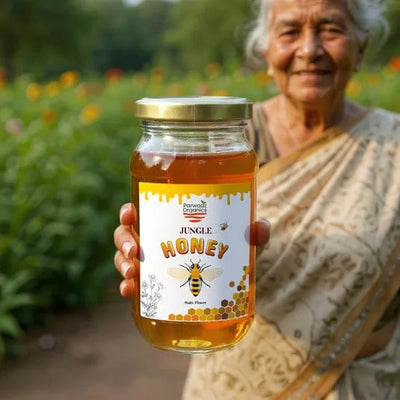
Multiple investigations have found that a large share of branded honey sold in India contains added sugar syrup — sometimes 50% or more. Here's how to check for purity:
- Cold water test — pure raw honey settles at the bottom in a thick lump; adulterated honey dissolves quickly
- Crystallisation — real raw honey turns grainy or solid in cooler weather; this is normal and a sign of authenticity
- Lab certification — look for NMR or CSIR-IHBT tested honey
How Much Honey Per Day Is Safe?
For healthy adults, 1–2 teaspoons of raw honey per day is a reasonable amount. This stays within recommended sugar limits, delivers a meaningful dose of antioxidants, and fits comfortably into traditional Indian routines (morning warm water with honey, or evening turmeric milk).
How to Choose the Best Honey in India
- Forest-sourced or single-origin — wild forest hives produce honey richer in antioxidants
- Raw and unfiltered — the label should explicitly say so
- Lab-tested — CSIR-IHBT or NMR certification is the gold standard in India
- Crystallises naturally — a brand that tells you their honey will solidify is being honest
Frequently Asked Questions
Is honey better than sugar for weight loss?
Marginally yes — because raw honey is sweeter than sugar, you tend to use less. It also has a lower glycemic index, leading to fewer insulin spikes and reduced cravings. But it's still a calorie-dense sweetener and should be used in moderation (1–2 tsp/day).
Can diabetics use honey instead of sugar?
Raw honey has a lower glycemic index than refined sugar, but it still raises blood sugar. Diabetics should always consult their doctor before substituting.
Which is better — honey or jaggery?
Both are better than refined sugar. Raw honey has a slightly lower GI and contains enzymes and antioxidants jaggery doesn't. Jaggery has more iron. For daily sweetening, raw honey is the more nuanced choice.
Why does my honey crystallize and is it still safe?
Yes, completely safe — and actually a sign of purity. Crystallisation happens because raw honey is a supersaturated sugar solution. Most commercial honey is pasteurised to prevent this, which destroys its enzymes.


What Should You Do Next?
Three simple next steps to put what you just read into practice.
New to Parwaaz?
Start with our Real Food Starter Ritual.
Made for families who want to begin preventive wellness with simple daily foods.