
How to Check Pure Ghee
Why Ghee Adulteration Is Widespread Ghee commands a significant price premium over refined oils, making adulteration economically motivated. Common adulterants include vanaspati (partially hydrogenated vegetable fat), refined palm oil, tallow...
Why Ghee Adulteration Is Widespread
Ghee commands a significant price premium over refined oils, making adulteration economically motivated. Common adulterants include vanaspati (partially hydrogenated vegetable fat), refined palm oil, tallow (animal fat), and starch. Because most adulterated ghee is mixed rather than replaced entirely, detection requires either laboratory analysis or specific chemical tests.
At-Home Identification Tests
- Melt test — pure desi ghee melts immediately when placed in the palm, even at slightly above room temperature (melting point ~32–38°C). Vanaspati-adulterated ghee feels firmer and melts less readily.
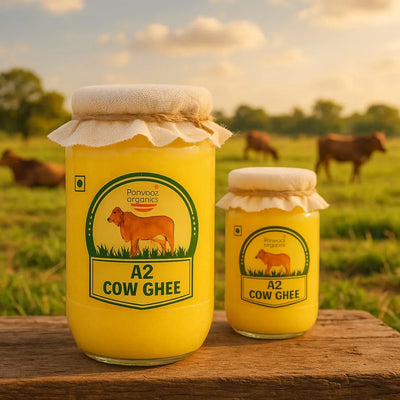
- Colour in liquid state — pure desi ghee from grass-fed A2 cows is golden-yellow due to beta-carotene. Adulterated ghee or commercial ghee from grain-fed cows is pale yellow to white.
- Texture on cooling — genuine bilona ghee shows a granular, crystalline texture when solidified at room temperature. Smooth, uniform solid texture is often a sign of hydrogenated fat mixing.
- Iodine test for starch — dissolve a small amount of ghee in warm water, add a drop of iodine solution. If the colour turns purple-black, starch is present — a common low-cost adulterant.
The Baudouin test detects sesame oil (often mixed as a marker chemical in vanaspati by regulation): dissolve 0.1ml ghee in 1ml HCl and add a few drops of furfural solution — a red or pink colour indicates vanaspati. This test is used in FSSAI laboratory protocols. At home, use it only as an indicator, not a definitive test.
Reliable Quality Markers
- FSSAI certification — mandatory; verify the FSSAI license number on the FSSAI portal
- Breed and process disclosure — genuine A2 Bilona ghee suppliers disclose the cow breed and process; vague labelling is a warning sign
- Aroma — genuine desi ghee has a rich, nutty, slightly caramel-like aroma. Adulterated ghee smells flat or slightly rancid.
- Smoke point — pure ghee smokes above 250°C. Adulterated ghee with vegetable oil will smoke at lower temperatures.
Shop This Topic

New to Parwaaz?
Start with our Real Food Starter Ritual.
Made for families who want to begin preventive wellness with simple daily foods.
Continue Exploring